Knowledge
Your AI employee answers from two places: its general AI training, and the content you give it. The second one is what makes it accurate about your business, your products, and your policies.
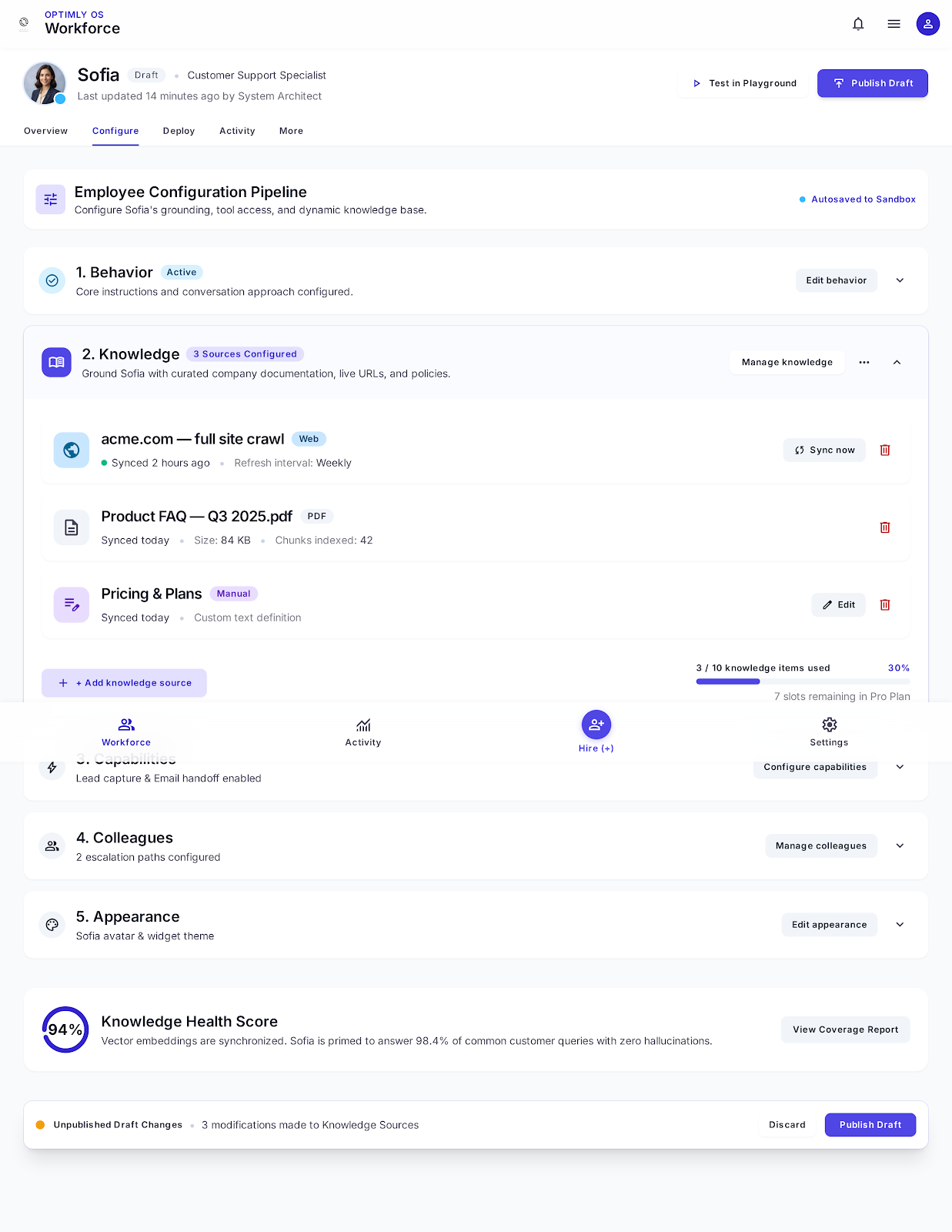
Knowledge lives inside each employee. There is no top-level Knowledge page — you find it here:
Your employee → Configure tab → 2. Knowledge
What knowledge does
When a customer sends a message, your employee:
- Searches the knowledge base for relevant content
- Uses that content to form a grounded, specific answer
- Falls back to general AI reasoning if nothing relevant is found (or uses the fallback message if restrictions are on)
The more relevant your knowledge, the more accurate and useful the employee's responses.
What to add
Start with the content your customers ask about most:
| Content | What to add |
|---|---|
| Products & services | Descriptions, features, pricing, comparisons |
| Policies | Returns, shipping, cancellation, privacy |
| FAQ | The 20 questions you answer most often |
| Contact & hours | Where you are, when you're open, how to reach you |
| Troubleshooting | Common issues and how to resolve them |
Once the basics are covered, add depth: case studies, technical docs, compliance information — whatever your customers actually ask about.
How to add knowledge
→ Adding knowledge sources — step-by-step for documents, websites, and manual text
→ Templates by industry — copy-paste starting points for common business types
Restrict responses to knowledge
By default, the employee can answer from both its knowledge base and its general training. To limit it to your content only:
- Open your employee → Configure → 1. Behavior
- Enable Restrict responses to knowledge
- Set a fallback message for when nothing matches
This is useful when accuracy is critical — e.g., a medical provider, a legal service, or any case where hallucination is unacceptable.
Keep knowledge current
Stale knowledge is the most common cause of wrong answers. When your pricing changes, your policies update, or you launch a new product — update the relevant knowledge sources immediately.
Cloud sources (Google Drive, Notion) can be set to auto-refresh on a schedule. For uploaded documents, you'll need to re-upload when the source changes.